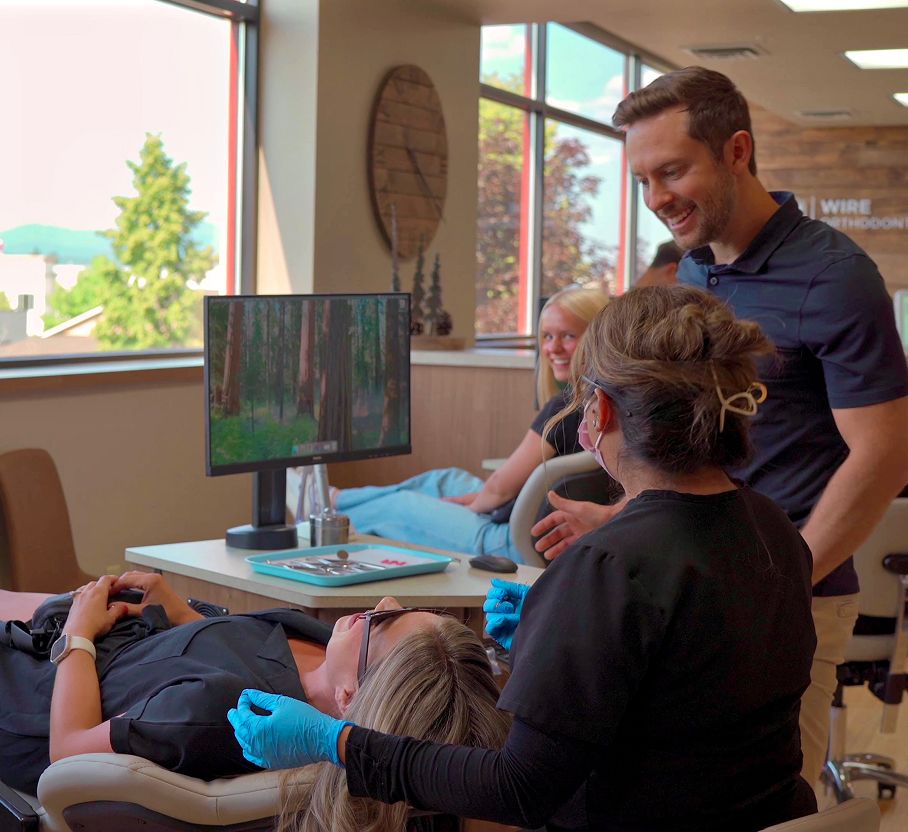

As a parent, you’ve probably wondered if those crooked baby teeth or that thumb-sucking habit means braces are in your child’s future. The truth is, the right time for orthodontic care isn’t always the teen years. At Wire Orthodontics, Dr. Clint Wire helps families understand when early intervention makes sense and when it’s better to wait. Knowing the signs can save your child from bigger problems down the road.
When Should Kids Get Braces?
Most children who need braces begin orthodontic care between the ages of 9 and 14, once most permanent teeth have come in. The first evaluation, though, should happen much earlier. The American Association of Orthodontists recommends every child see an orthodontist by age 7. That early visit gives Dr. Clint Wire the chance to spot developing concerns long before they turn into bigger problems, and to decide whether your child needs care now or simply needs monitoring.
What Is Early Orthodontic Treatment for Kids?
Early orthodontic treatment, also called Phase One treatment, is care provided to children typically between ages 7 and 10 while baby teeth are still present. The American Association of Orthodontists recommends every child have a first orthodontic evaluation by age 7. The goal of Phase One isn’t to straighten every tooth, but to guide jaw growth and bite development before problems become harder to fix.
Traditional braces for teens, by contrast, usually begin once most permanent teeth have erupted. This is called complete treatment, and it focuses on the final alignment of teeth and bite.
Phase One is sometimes called interceptive care because it intercepts a developing issue early. Think of it as guiding the foundation. Complete treatment finishes the work by fine-tuning the smile once all adult teeth are in place. Not every child needs Phase One. For some, monitoring is enough until the teen years. For others, acting early can prevent the need for extractions, surgery, or more complex orthodontic care later on.
How Orthodontists Decide When Kids Need Braces
Picture your child’s first appointment. A thorough exam comes first, followed by digital x-rays and growth imaging, then a careful look at jaw development alongside the eruption pattern of permanent teeth. Board-certified orthodontist Dr. Wire reviews these findings to determine whether to begin care now, schedule a follow-up to monitor growth, or wait until more adult teeth have erupted. Timing depends on each child’s unique development.
What Happens During the Evaluation?
At your child’s first visit, Dr. Wire performs a clinical exam, captures imaging, and reviews bite function and jaw alignment. He looks at how baby and adult teeth interact, how the upper and lower jaws fit together, and whether any habits (like thumb-sucking) are affecting development.
Why Does Timing Matter?
Between ages 7 and 10, children are in what orthodontists call the mixed dentition stage. Baby and adult teeth coexist, and the jaw is still growing actively. This growth window is a powerful tool. Certain corrections, like widening a narrow palate or addressing a crossbite, are much easier during these years than later when bones have fully developed.
Should You Act Now or Monitor?
Not every child needs immediate care. Many leave their first visit with a simple recommendation to return in six to twelve months for a growth check. Dr. Wire will only suggest starting Phase One if there’s a clear benefit to acting now rather than waiting. When the permanent teeth haven’t erupted enough to address a concern, waiting is often the better clinical choice.
What Are the Benefits of Catching Orthodontic Issues Early?
Spotting orthodontic issues early can save your child from more complicated care later, because treatment options expand and outcomes improve when concerns are caught during active growth. Here are the key benefits of early evaluation and Phase One treatment:
- Guides permanent teeth into better positions. Creating space early can help adult teeth erupt where they belong, reducing crowding.
- Corrects bite and jaw alignment during growth. Issues like crossbites and underbites respond much better to orthodontic care while the jaw is still developing.
- Reduces the need for extractions or surgery later. Addressing crowding or jaw discrepancies early often prevents the need to remove permanent teeth or undergo jaw surgery as a teen or adult.
- Improves breathing, chewing, and speech function. Widening a narrow palate or correcting an open bite can help with airway, eating, and clear speech.
- Shortens or simplifies later Phase Two treatment. When the foundation is set correctly, complete teen braces or Invisalign care is often faster and less complex.
The earlier a developing issue is spotted, the more options you have. That’s why the AAO recommends that first evaluation by age 7. Many families across the area discover that this single early orthodontic visit gives them real peace of mind.
Early Treatment vs. Waiting Until the Teen Years
One of the most common questions parents ask is whether their child needs braces now or if it’s better to wait. The honest answer: it depends. Some kids truly benefit from Phase One care. Others do best with a single round of orthodontic care in the teen years. A two-phase approach is reserved for more complex cases where both jaw growth and tooth alignment need attention.
How Do the Two Approaches Compare?
| Factor | Phase One (Early Treatment) | Single-Phase Teen Treatment |
|---|---|---|
| Typical Age | 7-10 years old | 11-15 years old |
| Primary Goal | Guide jaw growth and bite | Align all permanent teeth |
| Treatment Length | 6-18 months (varies) | 12-24 months (varies) |
| Best Candidates | Kids with crossbites, severe crowding, jaw discrepancies, harmful habits | Kids whose adult teeth are mostly in and need straightening |
| Follow-Up | Often followed by Phase Two in teens | Usually a single treatment phase |
As a board-certified orthodontist, Dr. Wire draws on his clinical expertise to guide which approach fits each child’s unique development, so families never have to guess at the right path.
When Do Two Phases Make Sense?
A two-phase approach is recommended when a child has a significant jaw or bite issue that benefits from early correction, followed by full alignment of permanent teeth in the teen years. Phase One sets the stage. Phase Two completes the smile.
When Is Waiting the Better Choice?
For many kids, monitoring is the right call. If your child has mild crowding and no functional bite issues, Dr. Wire may recommend waiting until more permanent teeth have erupted. Starting too early without clinical need can mean longer overall treatment time without added benefit. In these cases, patience truly is part of good kids’ braces planning.
What Affects the Cost of Kids’ Orthodontic Treatment?
The cost of kids’ orthodontic care depends on a few main factors: the type of care, the complexity of the case, the length of treatment, and which appliances are needed. Phase One care is typically shorter and uses fewer appliances. A full two-phase approach includes both early intervention and later complete care, which adds to the overall investment.
What Influences the Final Cost?
Treatment complexity is the biggest factor. A simple palate expander used for a few months costs less than a longer Phase One case involving partial braces and follow-up visits. Two-phase care, when clinically needed, costs more overall than a single phase. Yet it often prevents pricier interventions like extractions or surgery later. Think of it as paying a little now to avoid paying a lot down the road.
How Do Insurance and Payment Options Work?
Many dental insurance plans include orthodontic benefits for children. Coverage varies, so we’ll help you understand what your plan offers during your free consultation. Wire Orthodontics also provides flexible payment plans designed to fit family budgets. The value of early orthodontic care often goes beyond the price tag, since catching issues early can mean simpler care with fewer interventions over your child’s lifetime.
Signs Your Child May Need Braces (Candidacy Checklist)
Some orthodontic concerns are easy to spot at home. Others are subtle and only an orthodontist will catch them. Here’s a checklist of signs that suggest your child should be evaluated:
- Crowded, crooked, or blocked-out teeth. If adult teeth are coming in twisted, overlapping, or unable to find space, an evaluation is a good idea.
- Early or late loss of baby teeth. Baby teeth that fall out too soon or stay in too long can disrupt the eruption of permanent teeth.
- Eruption problems. Adult teeth that erupt in the wrong place, fail to come in, or appear behind baby teeth need attention.
- Bite issues. Watch for an overbite (upper teeth covering lower too much), underbite (lower teeth in front of upper), crossbite (teeth that don’t meet properly side to side), or open bite (front teeth that don’t touch when biting down).
- Thumb-sucking past age 5. Prolonged thumb or finger habits can affect jaw and palate development.
- Mouth breathing or snoring. These can signal a narrow airway or palate that orthodontic care may help address.
- Difficulty chewing or biting. If your child struggles to eat certain foods or favors one side of the mouth, the bite may be misaligned.
- Jaw shifting, clicking, or popping. Any unusual jaw movement or sounds deserve a closer look.
- Speech challenges. Lisps or trouble with certain sounds can sometimes be related to tooth position or palate shape.
- Facial asymmetry. A jaw that appears to grow more on one side than the other may benefit from early evaluation.
Have you noticed any of these signs? Scheduling a free consultation with Dr. Wire is a smart next step. Even if orthodontic care isn’t needed right away, you’ll have a clear picture of what to watch for. At Wire Orthodontics, a family-owned practice, you’ll see Dr. Wire at every visit, with the attention to detail you can trust from your first visit to your final reveal. We welcome patients of all ages at our two convenient locations, and our goal is exceptional treatment and amazing results. Schedule a free consultation today and get clear answers about your child’s smile you’ll love.
Frequently Asked Questions About Kids and Braces
What age should kids get braces?
Most children who need braces start care between ages 9 and 14, once most permanent teeth have erupted. The first orthodontic evaluation, however, should happen by age 7, as recommended by the American Association of Orthodontists. This early visit helps Dr. Wire decide whether to start Phase One treatment, monitor growth, or simply wait until the teen years.
Can a 7-year-old get braces?
Yes, in some cases. A 7-year-old may receive partial braces or appliances like a palate expander as part of Phase One treatment. This isn’t full braces on every tooth. It’s targeted, early care designed to correct specific issues like crossbites, severe crowding, or jaw development concerns while baby teeth are still present.
How long does early orthodontic treatment last?
Phase One treatment typically lasts between 6 and 18 months, depending on the issue being addressed. After Phase One, there’s often a resting period where Dr. Wire monitors your child’s growth and the eruption of permanent teeth. A second phase of care, if needed, usually begins in the early teen years.
Does my child need braces twice (two-phase treatment)?
Not necessarily. Two-phase treatment is reserved for kids with significant jaw or bite issues that benefit from early correction followed by full alignment in the teen years. Many children only need a single phase of braces or Invisalign as teens. Dr. Wire will only recommend two phases when there’s a clear clinical reason.
Is early treatment worth it if my child’s teeth look fine?
Sometimes, yes. Teeth that look straight from the front can hide bite issues, jaw discrepancies, or developing problems with permanent teeth. An evaluation by age 7 gives you peace of mind. If everything looks good, you’ll simply continue routine dental visits. If there’s a concern, you’ll have time to plan the right approach, with Dr. Clint Wire and our dedicated team guiding you every step of the way.