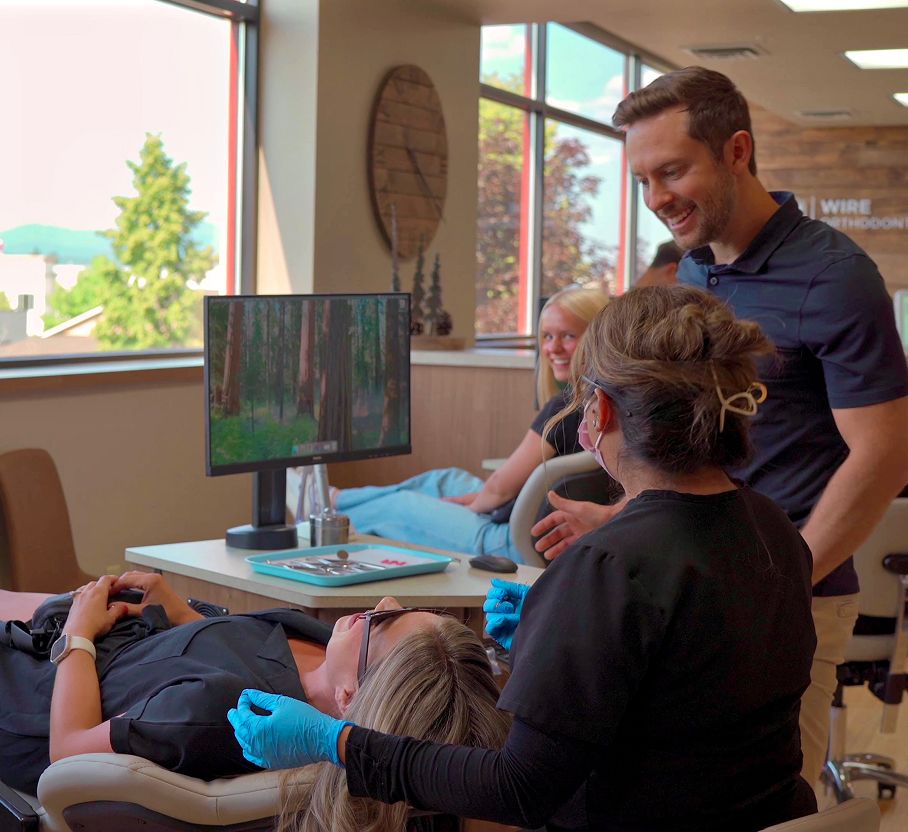

Modern braces are orthodontic appliances that straighten teeth and correct bite issues using brackets, wires, or clear aligner trays. Today’s options include sleeker metal brackets, tooth-colored ceramic braces, and Invisalign. These newer appliances work for children, teens, and adults alike, making orthodontic care more discreet and comfortable than ever before.
Braces have come a long way from the bulky hardware of decades past. Brackets are now smaller and more refined than the chunky versions many adults remember from their own youth. Wires use advanced metallurgy to apply gentler, more consistent pressure across the whole arch. Digital scanning has replaced messy impressions, allowing Dr. Clint Wire to map out orthodontic care with greater precision before a single bracket is ever placed.
This evolution means orthodontic care is no longer limited by age. If you’re a parent considering phase one treatment for your child or an adult finally ready to address long-standing alignment concerns, modern braces can give you the smile you’ll love.
What Are Modern Braces and How Have They Evolved?
The braces of today bear little resemblance to the appliances of a generation ago. Smaller brackets, smarter wires, and digital planning tools have reshaped what orthodontic care looks and feels like. Patients now have several appliance types to choose from, each suited to different needs, lifestyles, and bite concerns.
Where treatment once relied on guesswork and uncomfortable physical molds, careful digital mapping now guides each case from the start. That shift has made orthodontic care more predictable and far more comfortable, giving patients of every age realistic, attractive options that simply didn’t exist before.
How Do Modern Braces Work?
Modern braces work by applying gentle, continuous pressure that gradually shifts teeth into their proper positions. Brackets bonded to each tooth are connected by an archwire, which Dr. Wire adjusts periodically to guide movement. Invisalign achieves the same goal using a series of custom trays that you change every one to two weeks.
With traditional and ceramic braces, the archwire is the engine of movement. As Dr. Wire tightens or replaces it during follow-up visits at Wire Orthodontics, the wire transfers controlled force to the brackets, nudging teeth toward their ideal alignment. Most patients are seen every four to eight weeks during active orthodontic care.
Invisalign works a little differently. Each aligner in the series is designed to move specific teeth by small increments. You wear each tray for the prescribed time, then progress to the next one in the set. Because the aligners are removable, you simply take them out to eat, brush, and floss as you normally would.
Treatment length varies based on case complexity, but in most cases patients complete orthodontic care within 12 to 24 months. Once teeth are in position, retainers hold them there. Wearing your retainer as directed by Dr. Wire is what keeps your results looking great for years to come.
Benefits of Modern Braces for Every Age
Straightening your teeth does more than improve appearance. The benefits reach into daily comfort, long-term oral health, and how you feel about your smile when you greet the world each day.
- Better bite function. Properly aligned teeth and jaws make chewing easier and reduce uneven wear on tooth enamel.
- Easier cleaning. Straight teeth are simpler to brush and floss, which lowers the risk of cavities and gum disease over time.
- Improved confidence. A smile you feel good about can change how you show up at school, work, and family gatherings.
- Discreet treatment options. Ceramic braces blend with your natural tooth color, and Invisalign is nearly invisible during wear.
- Guided jaw development in children. Phase one treatment can address crowding, crossbites, or narrow palates while a child’s jaw is still growing.
Adults benefit because modern braces have removed the social barriers that once made orthodontic care feel out of reach for working professionals. For kids and teens, early intervention can reduce the need for more involved care later in life. Either way, the goal at Wire Orthodontics stays the same: healthy, confident smiles that last a lifetime.
Comparing Braces Options: Traditional vs Ceramic vs Clear Aligners
Choosing between traditional braces, ceramic braces, and Invisalign comes down on your goals, lifestyle, and the complexity of your case. Each option has strengths worth considering before you decide.
| Feature | Traditional Braces | Ceramic Braces | Invisalign |
|---|---|---|---|
| Visibility | Most visible | Tooth-colored, subtle | Nearly invisible |
| Best for | Complex cases | Moderate to complex cases | Mild to moderate cases |
| Removable | No | No | Yes |
| Eating restrictions | Some foods to avoid | Some foods to avoid | None (remove to eat) |
| Cleaning | Brush around brackets | Brush around brackets | Remove to brush and floss |
| Maintenance visits | Every 4-8 weeks | Every 4-8 weeks | Every 6-10 weeks typically |
Traditional braces remain the workhorse of orthodontic care. They handle the widest range of corrections and tend to be the most affordable choice for families on a budget. Ceramic braces offer the same proven mechanics with brackets that blend into your smile, which appeals to teens and adults who want a less noticeable look during treatment.
Invisalign suits patients who value flexibility. The trays come out for meals, brushing, and special occasions. As a Certified Invisalign Provider, Dr. Wire at Wire Orthodontics can determine whether aligners will achieve your goals or whether a fixed appliance is the better fit for your bite. Your free consultation is the place to sort all of that out.
What Affects the Cost of Braces?
The cost of orthodontic care depends on a handful of factors: the type of appliance you choose, how long you’ll be in treatment, and the complexity of your bite. Traditional braces are usually the most affordable, while ceramic braces and Invisalign often cost more. Insurance coverage and payment plans also shape your final monthly investment.
Here’s what typically influences the final investment:
- Type of braces or aligners. Traditional braces are usually the most affordable option. Ceramic braces and Invisalign often cost more due to materials and lab work.
- Case complexity. Minor crowding takes less time and fewer resources than correcting a significant bite issue or rotating multiple teeth.
- Treatment length. Longer treatment plans require more appointments and supplies over the course of care.
- One-phase versus two-phase treatment. Children who need phase one treatment followed by a second round of braces as teens will see different overall pricing than someone with a single course of care.
- Insurance and payment plans. Orthodontic benefits vary widely, and flexible payment options can make monthly costs more manageable.
Wire Orthodontics offers a free consultation so you can get a clear estimate before making any decisions. You’ll know what to expect, what your insurance may cover, and what payment options are available every step of the way.
Who Is a Good Candidate for Braces at Each Age?
Braces aren’t limited to teenagers anymore. The right time to start depends on your age, oral health, and exactly what you’re trying to correct in your smile.
- Children (ages 7 and up). The American Association of Orthodontists recommends a first orthodontic evaluation by age 7. At this stage, Dr. Wire can spot developing issues like crowding, crossbites, or jaw growth concerns. Phase one treatment, including palatal expanders, can guide jaw development before all permanent teeth erupt.
- Teens. This is the classic age for braces. Most permanent teeth are in place, and the jaw is still responsive to movement. Teens often have a choice between traditional braces, ceramic braces, or Invisalign Teen.
- Adults. It’s never too late to start. Braces and aligners work at any age, and adult patients make up a growing share of orthodontic care. If you’re correcting issues you’ve lived with for years or addressing shifting that happened over time, treatment can deliver amazing results.
Candidacy ultimately depends on your oral health, the type of bite issue you have, and your personal goals. A free consultation with Dr. Wire, a board-certified orthodontist, is the best way to find out which option fits you and your family.
Frequently Asked Questions About Modern Braces
How long do braces take?
Most patients complete orthodontic care within 12 to 24 months. Simple alignment issues may finish sooner, while more involved bite corrections can take longer. Your treatment timeline depends on the complexity of your case and how consistently you follow Dr. Wire’s instructions, including wearing rubber bands or aligners as prescribed throughout your care.
Are braces painful?
Mild soreness for a few days after placement or adjustments is normal and means the teeth are responding to treatment. Over-the-counter pain relievers and soft foods usually handle the discomfort with ease. Modern brackets and wires are designed to apply gentler force than older systems, which keeps day-to-day wear more comfortable than it used to be.
Can adults get braces?
Yes. Teeth can be moved at any age as long as your gums and bone structure are healthy. Many adults choose ceramic braces or Invisalign for a more discreet look during treatment. Dr. Wire treats patients of all ages and can recommend the best option based on your personal goals and lifestyle.
What is the best age for kids to start orthodontic care?
The American Association of Orthodontists recommends an evaluation by age 7. That doesn’t mean treatment will start right away. The early visit lets Dr. Wire watch how the jaw and permanent teeth are developing and step in at the ideal time if phase one treatment is needed.
Do clear aligners work as well as braces?
For mild to moderate alignment and bite issues, Invisalign can deliver outcomes comparable to traditional braces. More complex cases involving significant rotations, large gaps, or major bite corrections may still be best treated with fixed appliances. Your free consultation is where Dr. Wire will help you decide which path leads to the smile you’ll love, every step of the way.